
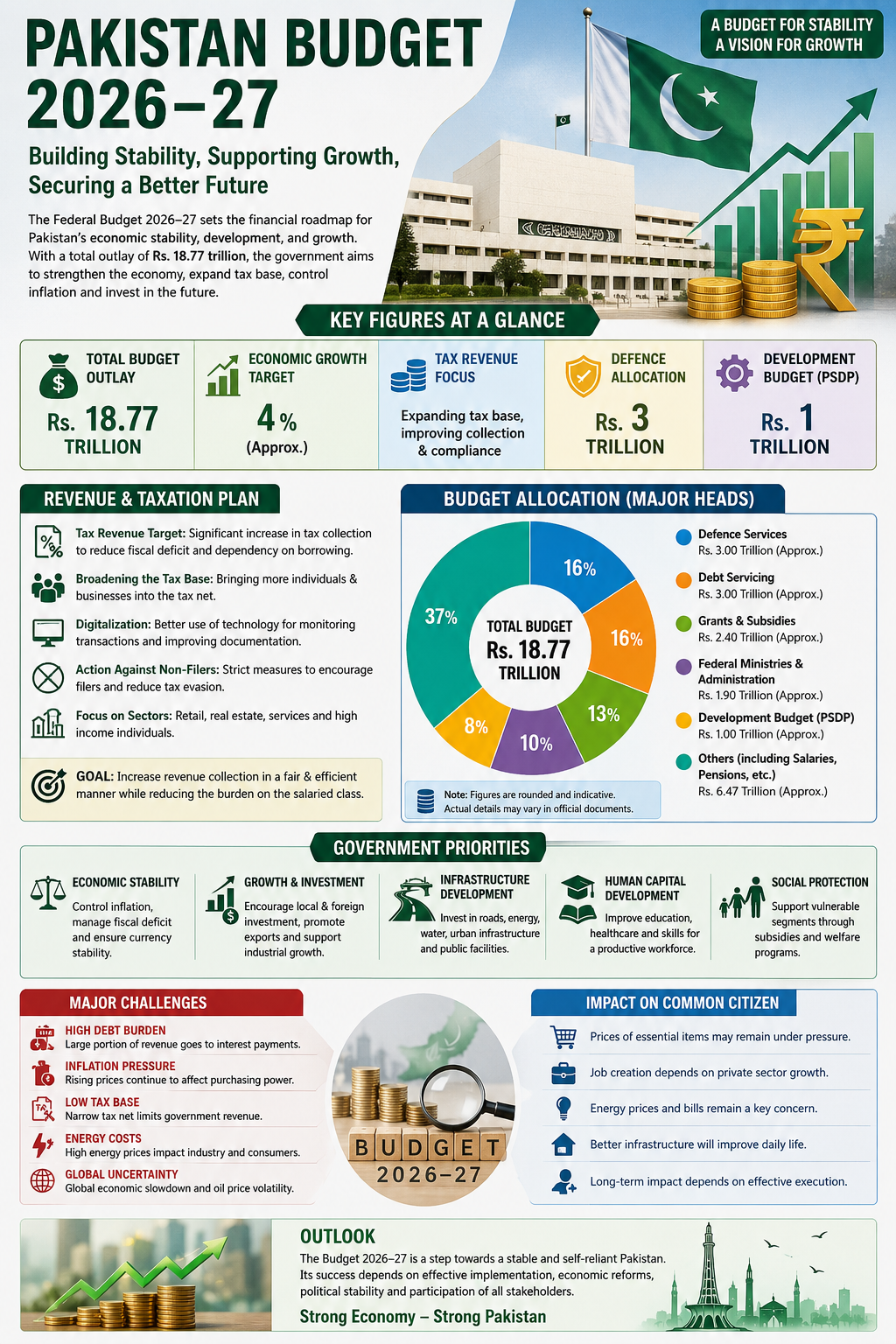

Pakistan’s Federal Budget 2026–27 is not just a financial statement — it is a complete economic strategy document that shows how the government plans to manage income, spending, debt, and development in a challenging economic environment.
The total budget reflects Pakistan’s struggle between economic stability vs. growth pressure, while also trying to satisfy IMF conditions, public needs, and national priorities.
📊 1. Total Budget Overview
The federal budget for 2026–27 is approximately:
💰 Total Budget Outlay: Rs. 18.77 trillion
This massive amount includes:
- Government running expenses
- Defence spending
- Interest payments on loans
- Development projects
- Subsidies
- Salaries and pensions
- Administrative costs
👉 This means most of the budget is not “new investment”, but management of existing economic obligations.
📈 2. Economic Growth Target
📊 GDP Growth Target: Around 4%
The government aims for moderate growth driven by:
- Agriculture recovery 🌾
- Industrial output 🏭
- Construction activity 🏗️
- Services sector expansion 💼
👉 However, achieving 4% growth depends heavily on:
- Political stability
- Energy supply
- Currency stability
- Foreign investment inflows
Without these, growth may remain limited.
🧾 3. Revenue & Tax Strategy (Most Important Part)
A key highlight of the budget is increasing tax revenue.
💰 Key Focus Areas:
- Expanding tax net (bringing more people into tax system)
- Increasing GST collection
- Digital monitoring of transactions
- Reduction in tax evasion
- Tight control on non-filers
👉 Pakistan’s biggest financial issue is NOT spending — it is low tax collection base.
⚠️ Challenge:
- Already high inflation
- Pressure on salaried class
- Business cost increase
So tax reforms are necessary but politically sensitive.
🛡️ 4. Defence Budget
🪖 Defence Allocation: Around Rs. 3 trillion
This includes:
- Military salaries and pensions
- Defence equipment and modernization
- Border security operations
- Strategic programs
👉 Defence remains one of the largest single expenditures due to security requirements.
🏗️ 5. Development Budget (PSDP)
🚧 Development Spending: Around Rs. 1 trillion
This is one of the most critical parts for future growth.
Major areas:
- Roads and highways 🛣️
- Energy projects ⚡
- Water infrastructure 💧
- Urban development 🏙️
- Education & health facilities 🏫🏥
👉 Development spending is relatively small compared to total budget, showing that:
Pakistan is still more focused on “running the system” than expanding it.
💸 6. Debt & Interest Payments (Hidden Pressure)
A large portion of the budget goes to:
- Loan repayments
- Interest on domestic debt
- External borrowing costs
👉 This creates a situation where:
a big part of revenue is already pre-committed before development spending
📉 7. Inflation & Public Impact
The budget indirectly affects:
- Food prices 🍞
- Electricity bills 💡
- Fuel prices ⛽
- Transport costs 🚗
Public concern:
- Salaries not increasing in line with inflation
- Cost of living rising faster than income
- Middle class pressure increasing
👷 8. Employment & Business Sector
Government expectation:
- Job creation through private sector
- Expansion of SMEs
- Industrial investment
Reality challenge:
- High energy cost
- Unstable currency
- Low investor confidence
👉 Job creation is mostly expected from private sector growth, not government jobs.
🌍 9. External Factors
Pakistan’s budget is also influenced by:
- IMF program conditions
- Global oil prices
- China-Pakistan economic projects
- Foreign loans and aid
- Export performance
⚖️ 10. Major Economic Reality
The budget shows a clear structure:
- 🧾 High revenue pressure
- 🪖 High defence spending
- 💸 Heavy debt burden
- 🏗️ Limited development space
👉 Meaning:
Pakistan is currently in a phase where stability comes before expansion.